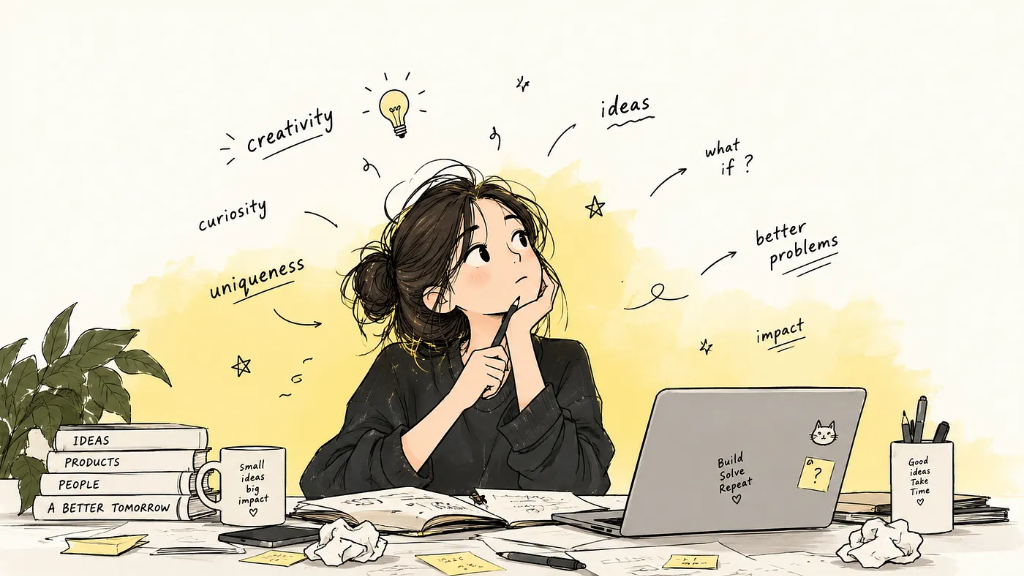
Four months of building has been replaced by however long it takes you to figure out what you actually want to build. The hard part isn't execution anymore—it's creativity, uniqueness, and taste.
I keep thinking about how a project used to take three, four months to build.
When I was in college, major project could easily take three, four months to build.
And even with all four of those months, you still couldn’t really build everything from scratch. You’d have to cut things. Scope it down. Leave out things you actually wanted to build. If you were lucky, the final version would just about hold together and work the way you wanted.
That’s not really true anymore.
A lot of what you need is already out there. Whatever you want to build, however you want to build it, you can get pretty far, pretty quickly. The gap between “I have an idea” and “I have something working” has become much smaller.
Four months of building has, in some ways, been replaced by however long it takes you to figure out what you actually want to build.
And that’s great. But it also changes the game.
If everyone can make something that works, something functional, something that looks good, then working isn’t really the difficult part anymore.
The thing that stays apart, the little bridge between one project and another, is creativity and uniqueness.
Did you notice something that others didn’t? Did you think of something that someone else wouldn’t have thought to build? Is there something about your idea that makes it yours?
That’s the part you can’t really shortcut.
And honestly, I wish I could just walk into a classroom right now and see how this is actually playing out.
How are professors grading projects now? How are students doing assignments? What does “doing the work” even mean when so much of the work can be generated?
I’m curious about this because I graduated right as this shift was happening. I have one foot in the time before all of this and one foot in whatever this new version of things is.
I know what it was like when building something was the hard part.
I don’t really know what it feels like to be a student now, when building might be the easiest part.
And I think that’s where the bigger problem is.
The hard part isn’t building anymore. It’s judging.
When everything can look impressive, how do you tell a good idea from a bad one?
A mediocre idea and a great idea can both have a good-looking website, a working product, a nice case study, and a convincing presentation.
They can both look like they took months to make.
So how do you actually tell them apart?
I don’t think we have a good answer for that yet.
Not in classrooms. Not in portfolios. Not in hiring.
We’ve gotten really good at making things look finished. But we haven’t gotten equally good at figuring out whether the thing itself is actually good.
I think that’s the more interesting part of what’s happening right now.
It’s not really that AI can build things. We already know that.
The bigger change is that the difficult part has moved.
It used to be execution.
Now, I think, it’s creativity, uniqueness, and taste.
Having an idea worth building. Knowing which problem is actually worth solving. Looking at a hundred things that all look impressive and being able to tell which one is actually good.
I don’t have a clean answer for how academics, hiring, or portfolios should deal with this.
But I think that’s a much more interesting question to think about right now than what AI can or can’t build.